
Emergency General Contractor Near Me: What North Las Vegas Homeowners Should Do First
If your first call after a roof collapse, burst supply line, or contractor abandonment is to Google “emergency contractor near me,” you’re already behind. The first 48 hours after a construction emergency determine whether you control the situation or the situation controls you. Here’s the sequence that actually protects your home, your money, and your legal options in North Las Vegas.
Most homeowners spend those critical hours doing the wrong things: calling their insurance agent before documenting anything, letting a well-meaning neighbor “patch” structural damage, or hiring the first contractor who answers the phone at 10 PM. We’ve watched these mistakes turn a $2,400 repair into a $24,000 claim denial. If you’d rather not navigate this alone, call Stonehall Construction at (833) 772-4634 and we’ll walk you through it.
What Counts as a Construction Emergency in North Las Vegas?
Before we get into the response sequence, let’s define what actually qualifies as an emergency. North Las Vegas homeowners face a specific set of risks that differ from other parts of the valley, and knowing the difference between urgent and merely inconvenient changes your first call.
True construction emergencies in North Las Vegas typically fall into four categories:
- Storm and monsoon damage: July through September brings monsoon-driven microbursts that can rip flashing, lift roof decking, and drive water into wall cavities. North Las Vegas sits in a slightly higher wind-exposure zone than central Las Vegas, particularly in neighborhoods north of Craig Road.
- Sudden structural failure: We’re talking about a cracked foundation wall, a sagging roof plane, or a failed beam. In North Las Vegas, clay-heavy soils in areas like Aliante and Eldorado expand and contract with irrigation cycles, which stresses slabs and stem walls over time.
- Water intrusion from failed plumbing or roofing: A supply line burst inside a wall, or a roof penetration that gives way during a storm. The damage compounds hourly as water wicks through drywall and insulation.
- Mid-project contractor abandonment: A remodel left torn open, unpermitted, or half-framed. This is more common than most people realize, and Nevada law gives you specific rights we’ll cover below.
What’s not an emergency: a cracked tile, a sticking door, a cosmetic drywall crack. Those can wait for a scheduled estimate. The distinction matters because emergency response costs more, and you don’t want to pay emergency pricing for a non-emergency condition.
The First-Response Sequence: What to Do in the First 24 Hours
Here’s the exact order. Write this down, screenshot it, whatever. Panic makes people skip steps, and skipped steps are how you forfeit insurance coverage and legal recourse.
Step 1: Document Everything Before You Touch Anything
Your phone camera is the most important tool you own right now. Before moving a single piece of debris, before mopping a single gallon of water, document the damage from every angle. Wide shots that establish context, then close-ups that show detail. Video walkthroughs work too. This documentation is what your insurance adjuster will review, and what a Nevada contractor’s bond claim will require.
What you’re capturing: the point of failure, the extent of spread, any personal property damage, and the condition of surrounding areas that were not damaged. That last part matters. It proves the damage was localized, not pre-existing.
Step 2: Stop the Bleeding, Safely
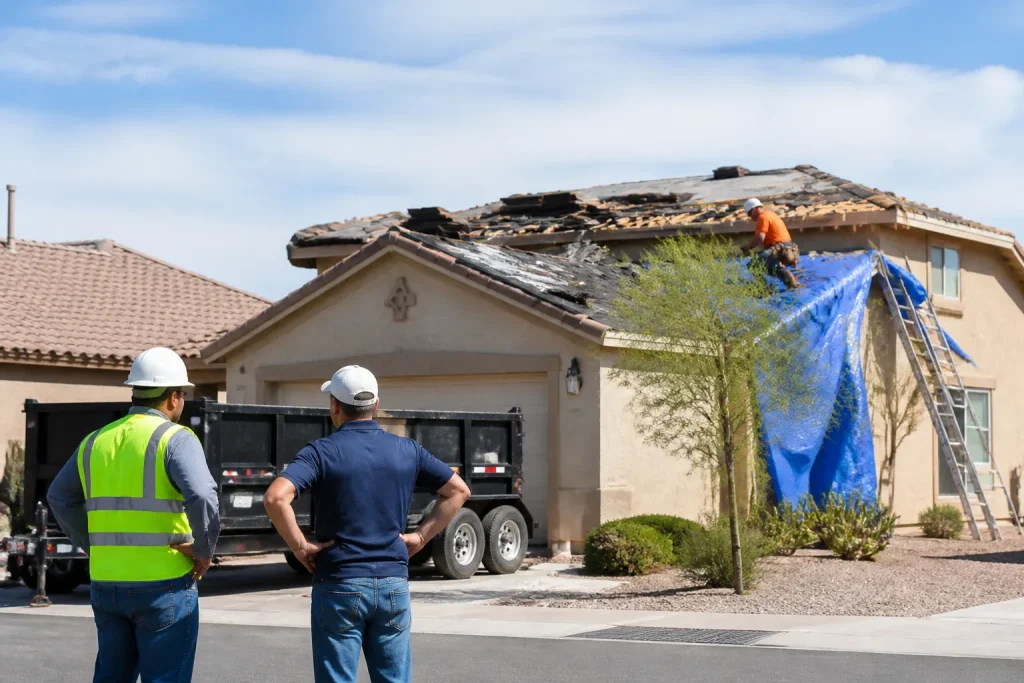
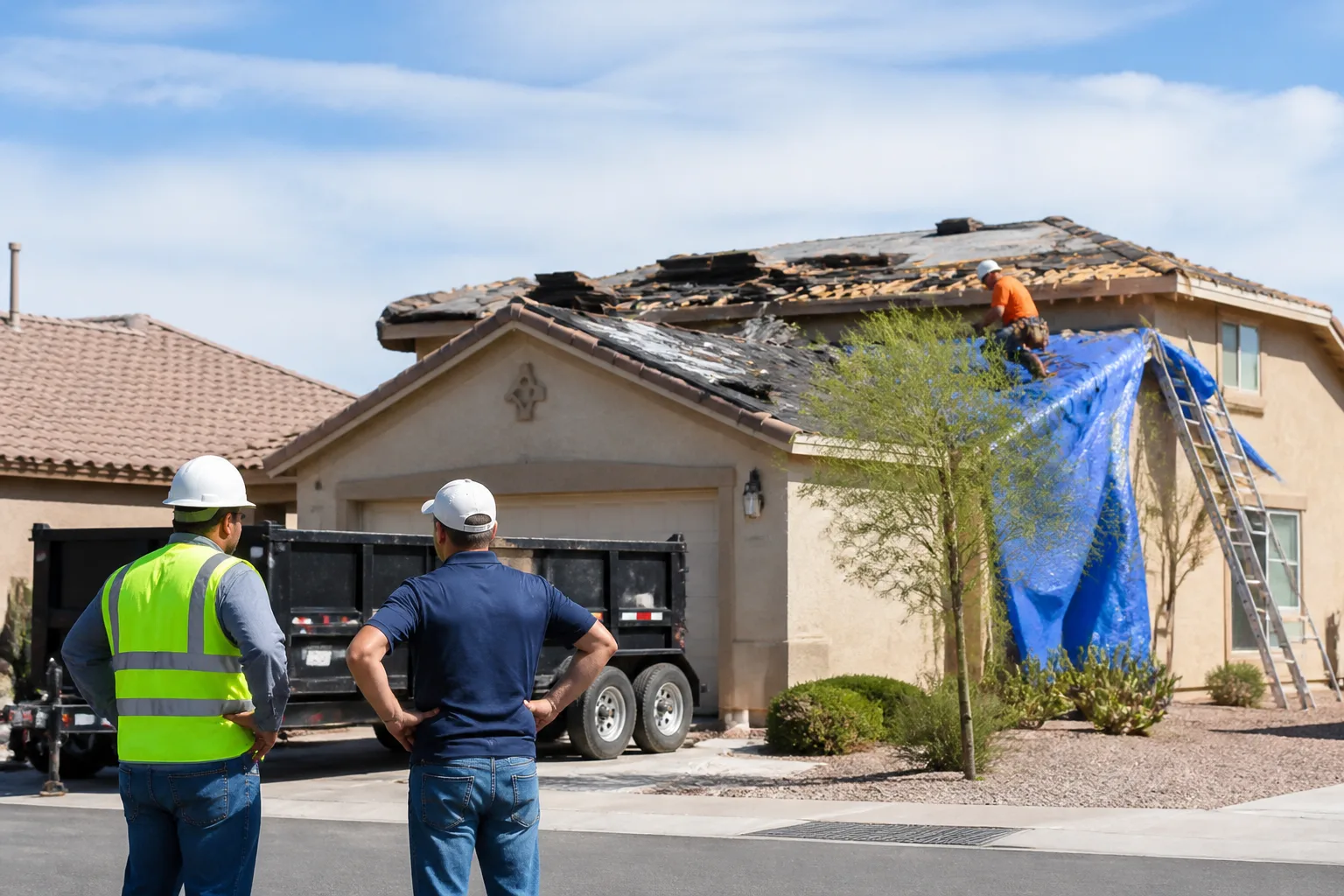
This is where homeowners get hurt and where we always flag the danger. If you have active water intrusion, shut off the main water valve at the meter. If you have exposed electrical wiring, kill the circuit at the breaker panel. If you have a sagging ceiling or a roof plane that’s visibly compromised, do not go up there. A wet ceiling can hold hundreds of pounds of water, and a compromised roof structure can fail catastrophically. Tarping a roof is a trained professional’s job, not a homeowner-with-a-ladder job. North Las Vegas has seen fatalities from exactly this scenario.
What you can safely do: place buckets, move valuable personal property out of the path of water, and if it’s safe to do so without touching electrical systems, shut off the water heater if it’s been submerged.
Step 3: Call Your Insurance Company, But Say the Right Things
Call your insurer within 24 hours. Full stop. But understand that the person on the other end is recording everything, and the words you use now will be quoted back to you during claim review. Say “sudden and accidental damage from [specific cause].” Do not say “it’s been leaking for a while.” Do not say “we’ve been meaning to fix that.” Those statements convert a covered claim into a denied one based on neglect.
Ask them to assign an adjuster and get the claim number. Do not authorize demolition or repair work over the phone. Do not accept a settlement offer on the spot. You need a contractor’s written scope and estimate first.
Step 4: Call a Licensed General Contractor
Not a handyman. Not a “guy who does insurance work.” A licensed Nevada general contractor who carries the proper bonding and insurance. Here’s why this order matters: when you call the contractor before the insurer sends an adjuster, the contractor can document the damage with the adjuster present, which eliminates the most common source of disputes, namely, that the homeowner “made things worse” before documentation occurred.
If you’re looking for a General Contractor in North Las Vegas, verify their Nevada contractor’s license through the Nevada State Contractors Board before letting them on the property. It takes thirty seconds online and it eliminates the unlicensed operators who prey on emergency situations.
Nevada Contractor Abandonment Law: Your Rights When a Contractor Walks Off
Contractor abandonment is a specific legal concept in Nevada, and it’s one of the most misunderstood protections homeowners have. NRS 624.3011 defines abandonment as a contractor failing to perform work without justification for a period of 30 days, or failing to respond to homeowner contact attempts. But here’s the part most people don’t know: you must document the abandonment properly to preserve your claim against the contractor’s bond.
What “documenting the abandonment” means in practice:
- Send written notice to the contractor at the address on the contract. Email works if your contract specifies email, but certified mail eliminates disputes about receipt.
- State the specific work that remains incomplete and give a deadline of no more than 15 days for response.
- Photograph the incomplete work from multiple angles, with date stamps.
- Keep every receipt for money paid, along with your contract and change orders.
- File a complaint with the Nevada State Contractors Board. This is the agent that can pursue a recovery claim against the contractor’s bond.
We’ve seen homeowners recover substantial costs through the bond process, but only when they had the paper trail to prove the abandonment. Without documentation, the bond claim stalls. The takeaway for North Las Vegas homeowners: if your contractor goes quiet, start documenting on day one of silence, not day thirty.
And when you need someone to take over a mid-project abandonment, that’s a different job than a fresh remodel. You need a GC who can assess what’s been done correctly, what needs rework, and what the permit status is. That’s a home renovation project with real technical complexity, especially if the previous contractor pulled permits that now show open status with the city.
How to Vet an Emergency Contractor Fast (Without a Panic Hire)
Emergency situations create a feeding frenzy of opportunists. You’ll have contractors knocking on your door within hours of visible storm damage. Some are legitimate. Some are what the industry calls “storm chasers,” crews that follow weather events and leave town when the work dries up. Here’s how to separate them in fifteen minutes.
The Three Questions That Matter
- “What’s your Nevada contractor’s license number?” A licensed contractor gives it to you immediately. A storm chaser starts explaining why they “don’t need one for this type of work.” Every contractor performing work over $1,000 in Nevada must hold a license. No exceptions.
- “Who pulls the permit?” The correct answer is “we do.” If they tell you to pull the permit as a homeowner’s permit, that’s a red flag. A homeowner’s permit shifts liability to you and often signals a contractor who can’t meet the licensing or insurance requirements for a permit pull.
- “Will you walk the scope with my insurance adjuster?” A contractor who’s done legitimate insurance restoration work will say yes without hesitation. A contractor who’s trying to inflate the claim or hide shoddy work will avoid the adjuster.
Then, before signing anything, check the Nevada State Contractors Board website for active complaints, and ask the contractor to show you a certificate of insurance with you named as an additional insured. Legitimate contractors do this routinely. Opportunists will hem and haw.
At Stonehall Construction, we’re a licensed general contractor, not a restoration specialist, and we’ll tell you if your emergency needs a specialist before we’d ever pretend otherwise. But for most structural damage in North Las Vegas, the scope spans multiple trades, framing, roofing, drywall, electrical, and that’s where a single full-scope GC saves you from coordinating four separate crews during a crisis. That’s the whole point of our Stonehall Construction home: one accountable team instead of a phone tree of subs.
What Your Homeowner’s Insurance Will and Won’t Cover in a Mid-Construction Emergency
This is the section where North Las Vegas homeowners lose real money. Here’s the reality most people learn too late:
What’s typically covered: Sudden and accidental damage from a covered peril. A monsoon microburst rips your roof decking, a burst supply line floods your kitchen, a vehicle hits your house. These are covered events, minus your deductible. The key phrase is “sudden and accidental.”
What’s typically NOT covered: Gradual damage. Long-term water intrusion from a roof that’s been failing for two years. A foundation crack that has been widening since 2021. A contractor’s defective workmanship, though that’s what their bond is for. And critically, damage that occurs because you failed to mitigate, the rain gets in through a hole you didn’t tarp, and now your framing is rotted. Your insurer will call that “failure to mitigate” and deny the claim.
What’s murky: Mid-remodel emergencies where a project was underway. If a contractor demolished half your kitchen and disappeared, your homeowner’s policy may treat the resulting exposure differently than a storm event. You need a written scope from a licensed contractor describing exactly what’s incomplete, what’s exposed, and what will cost what. That scope is the document that drives the claim conversation.
For North Las Vegas specifically, monsoon season claims spike between July and September, and adjusters in this market know the typical damage patterns. A detailed, contractor-documented scope in monsoon season gets settled faster than a homeowner’s verbal description of “the roof is just, like, broken.” If you’re planning a home remodeling project anyway, specify your insurance requirements up front so there’s no gap in coverage during construction.
North Las Vegas Emergency Risks Most Contractors Won’t Mention
Every market has its specific failure modes. Ours has three that show up again and again. Knowing them helps you spot early warning signs and pick the right contractor for the fix.
Monsoon water intrusion: Microbursts deliver horizontal rain that finds every failed seal, every cracked piece of flashing, every dry-rotted eave. Homes in North Las Vegas with original 1990s and 2000s roofing are at particular risk. We recommend inspecting roof penetrations and flashing before monsoon season starts, not after the first storm hits.
Extreme heat damage to exposed framing: North Las Vegas routinely sees 110°F-plus days in July and August. When a roof is torn off for replacement and left exposed for even a day or two, the framing members bake. Kiln-dried lumber that overheats can warp and check, which compromises the nailing surface for the new deck. A contractor who leaves your roof deck exposed in August is doing it wrong. Proper sequencing means the deck is protected or the replacement happens in a continuous flow.
Clay soil movement: Areas of North Las Vegas, particularly in the northwest and far north neighborhoods, sit on expansive clay. When irrigation patterns change, a backyard remodel suddenly changes water flow, or a monsoon soaks the soil, the clay swells and shrinks, and slabs move. The telltale signs are diagonal cracks at window corners, doors that suddenly stick, and separation at exterior step joints. This is a long-game issue, but a sudden version of it shows up after extreme wet-to-dry cycles.
In our experience, most “sudden” exterior failures in North Las Vegas are actually slow failures that finally reached a tipping point. That’s why we lean on material systems designed for this climate, like GAF and CertainTeed roofing assemblies with proper underlayment, and why we use hardscape brands like Unilock and Techo-Bloc that engineer for thermal movement. The material matters here. Generic pavers crack after one summer-to-winter cycle in our soil. We’ve seen it in Whitney Ranch and Aliante more times than we can count.
When to Call a Pro (and When You Can Wait)
Here’s the honest guidance we give homeowners during the initial phone call, before we ever schedule a site visit:
Call now if: water is actively entering the structure, a structural member is visibly sagging or cracked, you have exposed electrical wiring, or a contractor has abandoned a permitted project. These conditions worsen meaningfully within 24-48 hours, and delaying turns a contained repair into a full-system replacement.
You can schedule an estimate if: the damage is cosmetic, the water intrusion was a one-time event that has been fully dried, or you’ve noticed a new crack but nothing is moving. In those situations, take a breath. Get three estimates. Check references. A week won’t change your outcome.
We took over a project last year where a North Las Vegas homeowner had a contractor walk off mid-kitchen-remodel, leaving the range gas line disconnected and capped with a rag. That’s not an “eventually” call, that’s a “call someone who knows how to pull permits and re-certify the mechanical work” call. If you’re anywhere near a situation like that, call us at (833) 772-4634. Gas lines and abandoned permits are not DIY territory.
For related work that’s less urgent but just as important, see our full scope on home remodeling in North Las Vegas, or if you’re planning a whole-property overhaul, start with our home renovation services in North Las Vegas page.
The Bottom Line
The first 48 hours after a construction emergency in North Las Vegas follow a simple sequence: document everything, stop active damage safely, call your insurer with the right words, then call a licensed general contractor who can document scope alongside the adjuster. Skip the sequence and you’re betting against your own insurance policy and your legal protections under Nevada contractor law.
When you’re ready to get the damage assessed, Stonehall Construction offers free estimates, and we manage the full scope under one contract, whether that’s roofing, framing, drywall, or all of the above. If you’re in North Las Vegas and need help, call (833) 772-4634. One call, one team, the whole picture handled.
Frequently Asked Questions
Emergency response pricing in North Las Vegas typically runs 15-30% above standard project pricing due to overtime labor, expedited material handling, and emergency mobilization. A minor water intrusion repair with drywall and flooring replacement might run $2,500-$7,000, while roof deck replacement after monsoon damage can reach $12,000-$30,000 depending on square footage. Exact costs depend on your scope, and the only reliable number comes from a written estimate. Call (833) 772-4634 for a free assessment.
No. In Nevada, any contractor performing work over $1,000 must hold a valid license from the Nevada State Contractors Board. Hiring an unlicensed operator means you have no bond protection, no complaint process, and potential liability for injuries on your property. Verify the license before they start work.
Document everything immediately. Send written notice to the contractor’s address on file. Photograph all incomplete work. File a complaint with the Nevada State Contractors Board. Then retain a licensed general contractor to assess the incomplete scope and provide a written report that supports your bond claim and any insurance conversation. Call (833) 772-4634 if you need that assessment done.
Coverage depends on whether the damage was sudden and accidental, and whether you took reasonable steps to prevent further damage. A monsoon microburst that tears off roof decking mid-remodel is typically covered. Gradual water intrusion from work that was left exposed for weeks is typically not. Your adjuster will want written documentation from a licensed contractor defining the scope and cause. Get that documentation before you accept any settlement offer.
Written by the team at Stonehall Construction, serving North Las Vegas since 2013.
Need Construction Help?
Call Stonehall Construction - licensed & insured, with free written estimates in North Las Vegas.
(833) 772-4634